Choosing the Right Azure Integration Services Plan: Needs Over Wants
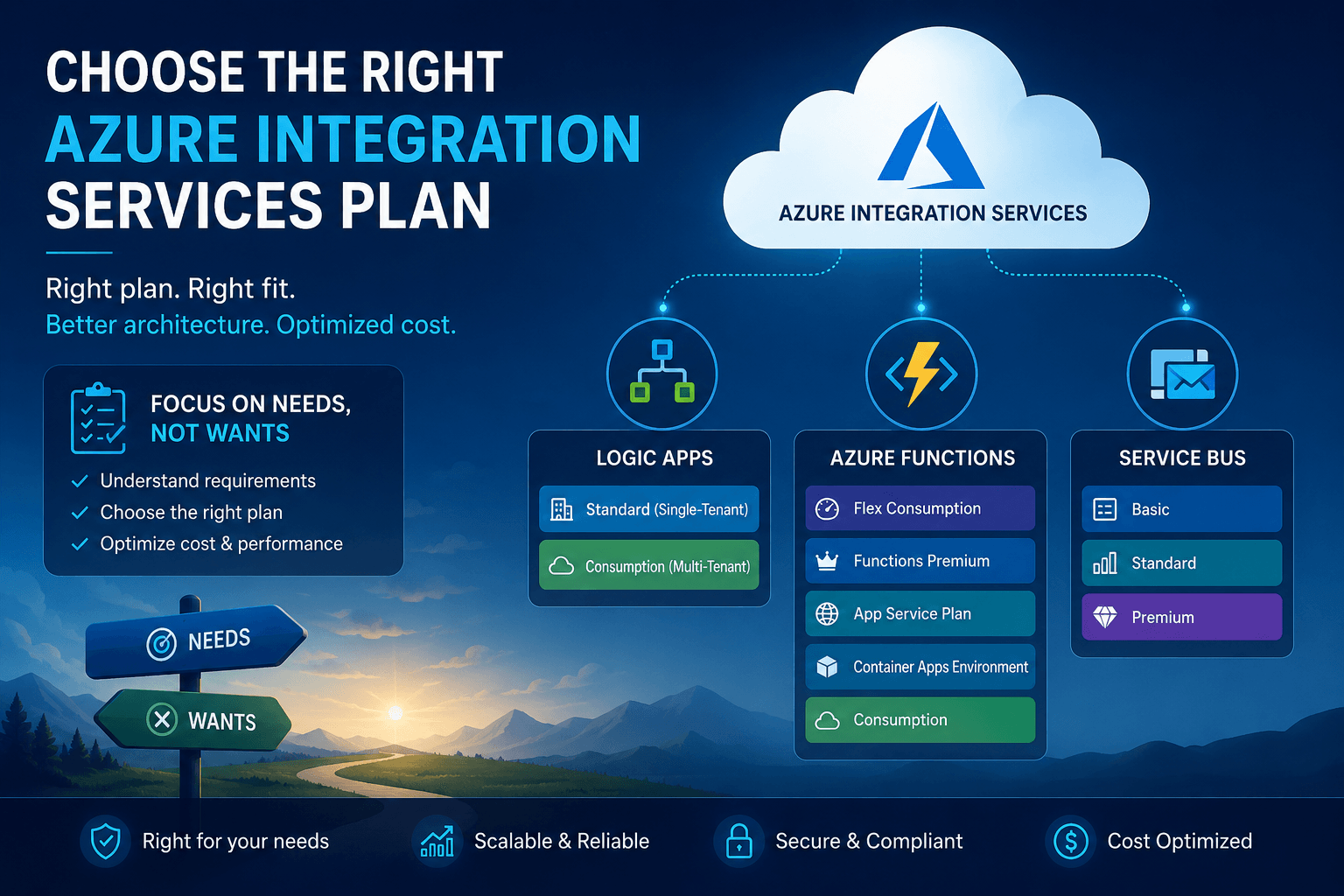
Azure Integration Services provides flexible options for building cloud-based integrations, from simple startup workloads to enterprise-grade platforms. Services like Logic Apps, Azure Functions, and Service Bus offer different plans, including Consumption, Standard, Basic, and Premium. The right choice depends on actual business and technical needs such as volume, security, networking, scalability, and reliability. Cost optimization is not about choosing the cheapest plan, but choosing the right plan for the right requirement.
Basic and Consumption plans are useful starting points
Across many Azure services, Microsoft provides entry-level options such as Basic or Consumption plans.
These plans are attractive because they usually have a lower upfront cost. In many cases, we pay only based on usage. This makes them useful for startups, proof of concepts, small integrations, and workloads where the volume is low or unpredictable.
For example, a Consumption-based model may be a good fit when the integration runs only occasionally or when we do not want to reserve dedicated capacity.
However, these plans may not include all advanced features. There can be limitations related to networking, message size, throughput, isolation, performance, and enterprise-level controls.
So, while these plans are cost-effective, they may not always be the right choice for every business scenario.
Premium plans provide more enterprise capabilities
Premium or higher-tier plans usually provide more capacity, better performance, stronger isolation, and advanced networking options.
For enterprise-grade integrations, these capabilities can be very important.
For example, when an integration needs private networking, predictable performance, high throughput, better control, or stronger reliability, a premium option may be more suitable.
This does not mean that premium is always the right choice. It simply means that premium plans are designed for scenarios where the business requirement justifies the additional cost.
The real decision is not about features alone
When choosing a platform or plan, it is easy to focus only on the features.
But architecture should not be based only on what is available. It should be based on what is actually needed.
There is a difference between needs and wants.
A team may want premium features, dedicated capacity, advanced networking, and high scalability. But the real question is whether the current business requirement needs all of them.
At the same time, choosing the cheapest plan only to reduce cost can create problems later. If the platform cannot handle the required volume, security, reliability, or operational needs, the cost saving may become a technical risk.
Key factors to consider before choosing a plan
Before selecting a plan, we should understand the actual requirements clearly.
Some important questions are:
- What is the expected integration volume?
- Is the workload predictable or unpredictable?
- Are there any private networking requirements?
- Is high availability required?
- What are the security and compliance expectations?
- What is the expected message size and throughput?
- How critical is the integration to business operations?
- Will the workload grow in the future?
- What level of monitoring and operational control is required?
Once these questions are answered, choosing the right plan becomes much clearer.
Cost optimization is not choosing the cheapest option
Cost optimization is often misunderstood.
It does not always mean selecting the lowest-cost plan.
Real cost optimization means choosing the right plan for the right requirement.
If we choose a plan that is too small, we may face performance issues, limitations, or rework later. If we choose a plan that is too large, we may end up paying for capacity and features we do not actually need.
The goal is to find the right balance between cost, capability, scalability, and reliability.
Final thoughts
Azure Integration Services gives us a flexible platform for building integrations in the cloud. The same ecosystem can support simple startup integrations as well as complex enterprise-grade integration landscapes.
But the success of the architecture depends on making the right choices.
When selecting between Consumption, Standard, Basic, Premium, App Service, or other hosting options, we should not make the decision based only on features or assumptions.
We should first understand the business needs, technical requirements, operational expectations, and future growth.
When we understand the needs clearly, the right platform choice becomes easier.
Conclusion
Cost optimization is not about choosing the cheapest option. It is about choosing the right option for the right requirement.