Azure AI Foundry – Connecting AI Agents with Real Business Workflows
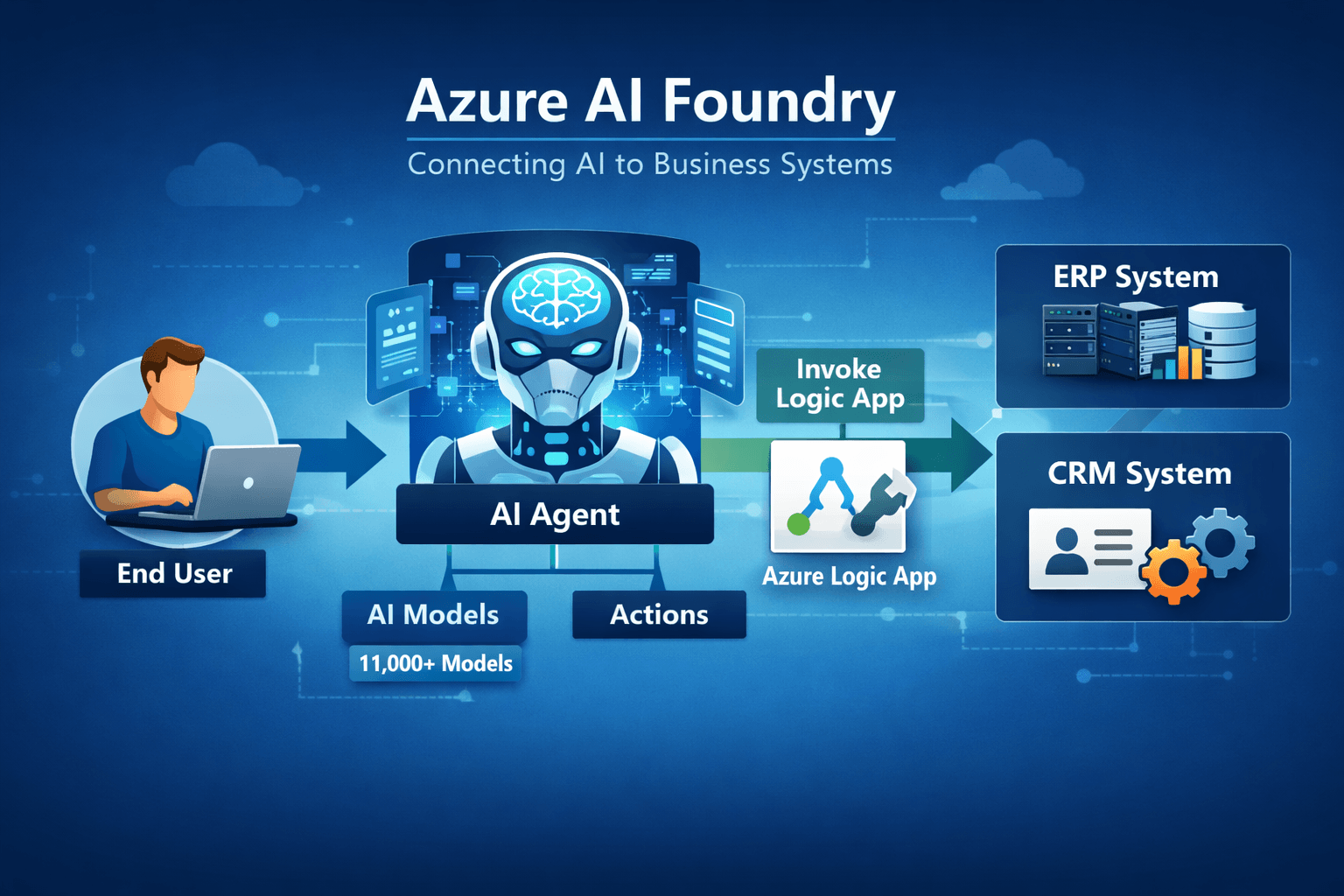
Azure AI Foundry brings together Azure OpenAI, AI Services, and Content Understanding into a single platform, offering access to 11,000+ models. It allows you to create AI projects with multiple agents, each tailored for specific use cases. A key capability is agent actions, where agents can trigger workflows such as Azure Logic Apps to interact with backend systems like ERP and CRM. This enables reuse of existing integrations while letting AI act as a decision layer. Although still evolving, it shows strong potential for connecting AI with real business processes.
What is Azure AI Foundry?
Azure AI Foundry is Microsoft’s unified platform for building AI solutions. Instead of working with multiple services separately, everything is accessible in one place.
It combines:
- Azure OpenAI
- AI Services
- Content Understanding
The platform also provides access to 11,000+ models, giving flexibility to choose based on use case, performance, or cost.
AI Projects and Agents
The core concept in Foundry is the AI Project.
Within a project:
- You can create multiple agents
- Each agent can be configured for a specific scenario
- Different models can be used per agent
This allows you to design AI systems in a more structured way rather than building one generic solution.
For example:
- One agent for customer queries
- One agent for document processing
- One agent for internal automation
Agent Actions – The Real Value
This is where things get interesting.
Agents are not limited to just responding to users. You can define actions, which allow agents to interact with external systems.
For example:
- Call an API
- Trigger an Azure Logic App
- Execute backend workflows
This means the agent can:
- Understand the user input
- Decide what needs to be done
- Trigger the appropriate system
Connecting with Azure Logic Apps
From an integration standpoint, this is a strong capability.
You can connect an agent action to an Azure Logic App, which then:
- Integrates with ERP systems
- Connects to CRM platforms
- Handles orchestration and transformations
This approach has a big advantage:
- You don’t need to rebuild your existing integrations
- You simply plug AI on top of your current architecture
The agent becomes a decision layer, while Logic Apps continues to handle orchestration.
Practical Perspective
From my experience:
- The concept is powerful
- The integration possibilities are very relevant for enterprise use
- It fits well with existing Azure Integration Services
But:
- It’s still evolving
- Some agent decisions fail or behave unpredictably
- Certain actions (like tools) may not always work as expected
So, I would treat it as something to explore and experiment with rather than rely on fully for production today.
Conclusion
Azure AI Foundry is a step towards making AI more actionable in real-world systems.
Instead of just generating responses, agents can now:
- Make decisions
- Trigger workflows
- Integrate with enterprise systems
For someone working in integration, this opens up a new layer — where AI sits on top of existing processes and drives execution.
It’s not perfect yet, but definitely a space worth watching and experimenting with.